You're getting ready for a night out, favorite earrings in, and somewhere between dinner and the car ride home, one goes missing. Now what?
At Homebody, we think the best move is knowing your coverage before that moment ever happens. Here's how jewelry insurance actually works, what it pays out, and where the gaps are.
This article covers general information, not personalized financial advice. Talk with a licensed insurance agent about your specific policy and jewelry collection.
Does homeowners or renters insurance cover jewelry?
Your renters insurance or homeowners policy probably covers jewelry, but only up to a point.
Most standard policies cap jewelry theft coverage around $1,000 to $2,500, with $1,500 being a common benchmark (Policygenius). That cap can apply per item or as a total across your whole collection, depending on the insurer. So a $10,000 engagement ring or a family heirloom necklace can leave you badly underinsured if that's all you're relying on.
There's another catch: standard homeowners policies (the common HO-3 type) typically only cover jewelry against named perils like fire or theft. If a ring just vanishes with no explanation — what insurers call "mysterious disappearance" — that's usually not covered at all (III). That's a bigger gap than most people realize, since lost jewelry is far more common than stolen jewelry.
Getting a separate jewelry insurance policy
Once your jewelry's value outpaces your homeowners or renters limits, a dedicated jewelry insurance policy is worth a look.
Scheduled personal property coverage. This is an add-on to your existing homeowners or renters policy. You list specific pieces — that ring, that watch — and insure each for its full appraised value, backed by an appraisal or receipt.
Standalone jewelry insurance. Companies like Jewelers Mutual specialize in this. Filing a claim on a piece of jewelry won't touch your home insurance rates, and these insurers typically have in-house experts for evaluating and restoring antique or unique pieces.
Both options typically cover mysterious disappearance, unlike a standard homeowners policy — often the single biggest reason to schedule valuable pieces.
What jewelry insurance actually covers
Most policies, whether scheduled or standalone, cover the same core scenarios:
Damage. A house fire, a spill, a dropped ring down the drain — accidental damage is covered so you can repair or replace without eating the cost yourself.
Loss or theft. Left it at a hotel, or it was stolen at an event — both are typically covered, including mysterious disappearance on most dedicated policies.
A range of jewelry types. Everyday pieces and heirlooms alike can be insured, though high-value items usually need their own appraisal to be scheduled properly.
What jewelry insurance won't cover
Pre-existing damage. A scratch or dent from before the policy started won't get paid out.
Wear and tear. Tarnishing, loosening prongs, general aging — normal wear isn't a covered "loss."
Intentional damage. Self-inflicted damage, including DIY modifications gone wrong, isn't reimbursable.
Pest damage. Yes, this is a real exclusion. Damage from pests isn't typically covered.

What does jewelry insurance cost?
Standalone policies typically run 1% to 2% of the jewelry's appraised value per year, though rates from 0.5% to 3% aren't unusual depending on the insurer and your location (BriteCo). A $10,000 ring might cost $100–$200 a year to insure; a $25,000 ring, roughly $250–$500.
Scheduling jewelry under homeowners/renters insurance usually adds a modest premium increase rather than a separate policy cost, but you're still working within your carrier's overall limits and terms.
Storing jewelry in a safe deposit box can sometimes lower your premium, since it reduces theft risk. Insurers will generally want an appraisal or detailed receipt before setting your premium either way.
How payouts actually work: ACV vs. replacement cost
When a claim is approved, insurers calculate the payout one of two ways:
Actual cash value (ACV). Pays the replacement value minus depreciation. Jewelry doesn't depreciate the way a car does, so ACV payouts on jewelry can be lower and more disputed than you'd expect.
Replacement cost. Pays what it actually costs to replace the item today, no depreciation subtracted. This is usually the better deal for jewelry specifically, since jewelry tends to hold or gain value rather than lose it (Jewelers Mutual).
Some dedicated jewelry policies skip the calculation altogether and just replace the item with a comparable one, coordinated through a specific jeweler or repair service. Having your appraisal or receipt on hand makes that process faster and more accurate.
Traditional jewelry insurance model
In the conventional insurance policy, particularly the ones associated with jewelry coverage under most homeowners’ insurance policies, the process is fairly direct. Let’s check it out:
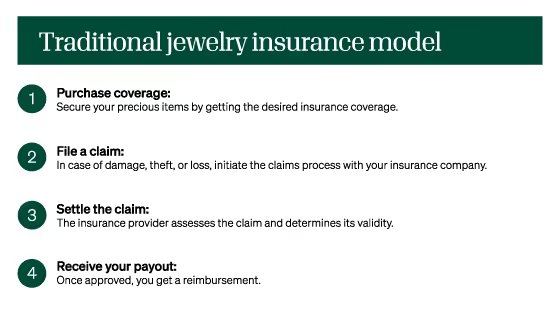
Filing a claim
Under homeowners or renters insurance: if it's theft, file a police report first, then bring that report to your insurer. Your payout will be reduced by your policy's deductible.
Under a standalone jewelry policy: contact your insurer directly. They'll likely point you to a jeweler for repair or evaluation. Most jewelry-specific policies and floaters carry no deductible, or a very low one ($0–$250), which is a real advantage over a standard homeowners claim (Insurance.com).
Is jewelry insurance worth it?
If your jewelry's value is well above your homeowners or renters coverage limit, or if losing it (not just having it stolen) would actually hurt, a dedicated policy or scheduled endorsement is the more reliable path. Compare the annual cost against what you'd be out if the worst happened, and weigh whether you want ACV, replacement cost, or a guaranteed replacement model.
Warranties and service plans aren't insurance, but they help
Insurance handles the unexpected: theft, loss, damage. Warranties and service plans handle the predictable stuff — cleanings, prong tightening, setting checks — that keeps a piece from needing an insurance claim in the first place. Neither replaces the other; they work best together.
Bottom line
Your jewelry carries more than resale value. Know what your current policy actually covers, close the gaps with scheduled coverage or a standalone policy where it makes sense, and reach out to our team if you want a hand comparing your options.
Jewelry is often one of our most valued (and valuable) possessions. If your favorite piece of jewelry is lost or damaged, it can quickly send you into a panic mode. We'll explain how to make sure your jewelry is protected, file a claim, and receive an insurance payout so you can reclaim your peace of mind.

.avif)