Whether you're gearing up for a big purchase or just want a pulse check on your finances, here's how to actually see your FICO score for free, and what it means once you do.
This is general information, not personalized financial advice. For decisions tied to your specific credit situation, talk with a financial advisor or credit counselor.
What is a credit score?
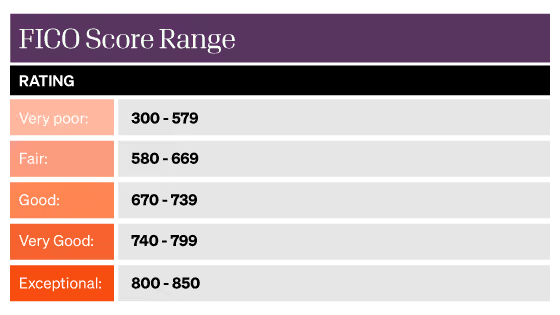
A credit score condenses everything in your credit report into a single number lenders use to judge your credit risk. The two most common models are FICO and VantageScore, and while they weigh similar factors, they don't always produce the same number. Scores run 300 to 850, and higher is better across the board:
- Very poor: 300-579
- Fair: 580-669
- Good: 670-739
- Very good: 740-799
- Exceptional: 800-850
FICO is the one that matters most in practice — most lenders use it for mortgage, auto, and credit card decisions, even though free tracking tools often show you a VantageScore instead (more on that below).
Credit score vs. credit report
These get used interchangeably, but they're different things. Your credit report is the underlying record: every credit account you've had, your payment history on each, balances, credit limits, and public records like bankruptcies. Your credit score is a number distilled from that report.
You're entitled to a free credit report from each of the three bureaus (Experian, Equifax, TransUnion) at AnnualCreditReport.com — and as of the pandemic-era rule made permanent, that's now weekly, not just once a year. One catch worth knowing: that free report does not include your credit score. The score itself typically comes from a separate source.
How to actually check your FICO score for free
Through your bank or card issuer. Many banks and credit card companies show your FICO score right in your online account or app, updated monthly, as part of the FICO Score Open Access program. Discover's Credit Scorecard is a standout here — it's free to anyone, not just Discover customers. American Express and other issuers offer similar free access to cardholders.
Through Experian or myFICO directly. Experian offers a free FICO Score 8 through its own site (separate from AnnualCreditReport.com). myFICO.com also offers a free monthly FICO Score 8 based on your Equifax report.
A word on Credit Karma and similar apps. These are genuinely useful for tracking trends over time, but worth knowing: Credit Karma shows a VantageScore, not a FICO score. It's not wrong or unsafe, just a different number calculated a bit differently, so don't be surprised if it doesn't match what a mortgage lender pulls.
Watch for scams. Stick to bureau sites, your bank, or well-known services. Be wary of any "free score" site that asks for a credit card number upfront.
Non-profit credit counselors. If you want a person walking you through it, a non-profit credit counselor can pull your reports, explain what's dragging your score down, and check in over time as you work on it.
What's actually in your credit report
Beyond the score itself, your report includes your personal and contact information, your open and closed credit accounts (type, balance, limit, and status), your payment history, hard and soft inquiries, collections accounts, and any dispute statements or fraud alerts you've filed.
It also includes certain public records — bankruptcies and tax liens. One correction worth flagging: civil judgments used to appear here too, but the three major bureaus stopped including them back in 2017 under a nationwide settlement, since most judgments don't carry enough identifying information to meet reporting standards. A judgment can still show up through other channels lenders use, just not on your standard credit report anymore.
What to do after you check your score
Whatever number you see, a few things are worth doing next:
Check the report behind it for errors. An unfamiliar account, a wrong balance, or a payment marked late that wasn't — these drag your score down for no reason and are worth disputing.
Understand where you land. Knowing whether you're in fair, good, or very good territory tells you roughly what terms you'll qualify for, and how much room there is to improve.
Know what's driving the number. Payment history and credit utilization make up the majority of your score. If something's off, it's almost always one of those two.
Set a real target and track it. Rather than checking obsessively, revisit your score every month or so and measure it against a specific goal — pay down a balance, fix an error, hit a score threshold before a big application.
Watch for signs of fraud. An account or inquiry you don't recognize is worth investigating immediately, not just noting.
If you're not sure where to start, a credit counselor (mentioned above) can turn this into an actual plan instead of a list of good intentions.
Why your score looks different on different sites
It's normal to see your score vary by a few points, sometimes up to around 20, depending on where you check it. This comes down to two things: each bureau may have slightly different information on file (not every creditor reports to all three), and different platforms use different scoring models — FICO versus VantageScore, or even different versions within each. A gap of a few points doesn't change what tier you're in or what it means for your finances. A gap of 50+ points is more often a sign that one bureau has an error worth investigating.
Understanding and tracking your FICO credit score is important for keeping your finances in good shape. Whether you're planning to buy something big (like a new car) or just want to keep an eye on your credit status, we'll show you how to check your FICO score for free and explain how having a good score can open doors to better financial opportunities.